Showing posts with label Rockies. Show all posts

Sunday, 14 June 2015


Have you ever noticed that when arrangements are made to go somewhere, especially those plans made earlier in the year or the year before -- seem to go awry just before one is about to depart. Perhaps I should just go on the spur of the moment and hope for the best; something I did when younger -- and it worked out just fine.

The photo is from a post about hiking the Rockwall Pass in Kootenay National Park in British Columbia.


Photo Credit: nordique CC=flickr.

Thursday, 21 May 2015

Plains Bison in Banff National Park


Plains bison were reintroduced into Banff National Park in March 2015.


For those unable to watch embedded see here.


In the mid-1800s the majority of Plains Bison had been eliminated from the continent except for a few free ranging herds. They have always had a role in the ecosystem by their creation and maintenance of grasslands and meadows through grazing and physical disturbance of the ground. Bison are also a food source to predators.

The First Nations and pioneers benefited from the bison in years past. This reintroduction will assist the cultural reconnection which has been lost for over a century.

A long-term maximum population for Banff will be in the range of 600 – 1,000 individuals. To protect the initial relocation area it will only be accessed by established trails on foot or on horseback. For those who venture too closely the bison can create safety risks such as human fatalities. They weigh 450-900 kilograms, are agile for their size and capable of speeds up to 70 kilometres an hour. The areas of “the Panther and Red Deer River valleys, and the Fairholme Bench area of the lower Bow Valley” are locations that have the appropriate range habitat to support the bison.

The first phase of the reintroduction includes placing 30-50 bison in a temporary soft release paddock in the Panther-Dormer River area in the summer/fall. These plains bison will come from the herd at Elk Island National Park. The phasing in period will be over the next five years and beyond. Currently the Dormer River Valley is closed for prescribed fired burnings which will enhance new vegetation growth for the plains bison to be placed there.

This is exciting as it has been quite some time that Banff National Park has had the plains bison available to the public. During some of my early visits to Banff in childhood (late 1950s-1962), I recall seeing the plains bison in the various paddocks.


Research: ParksCanada

Sunday, 10 May 2015

Cascade Gardens


The Banff Administration Building is located on the south side of the Bow River across the Bow River Bridge. The Cascade Gardens surround the stone building and are built into the hillside of Sulphur Mountain. These gardens offer spectacular views of the Bow River and the surrounding mountains.

More information on summer and winter activities can be located in Parks Canada's brochures.


Photo Credit: Fred Hsu CC=flickr

Friday, 22 March 2013


Once again, Blogger has decided to play games on whether I am allowed to upload photos for a hiking post on a trail in Glacier National Park in British Columbia.

However, this photo of Spirit Island at Maligne Lake in Jasper National Park, Alberta will suffice for the time being.

Photo Credit: alpeck99 CC=nc-nd-flickr CLICK TO ENLARGE

Thursday, 21 February 2013


This photo is of Consolation Lakes located in Banff National Park, Alberta.

I had intended on posting the book review on The Urban Fantasy Anthology, but for some reason Blogger insists on refusing the cover photo to upload.

From time to time I upload photos I intend on using in future posts, and this one was available. A previous post on hiking the Consolation Lakes is here.

The weather in Toronto continues to switch from week to week: snow and chilling winds bringing the temperature down to -25C and the next week 3C with rain. There have been major earthquakes over the last ten years that have been shifting the north pole to the NE degree by degree, which has an impact on weather everywhere on the planet.


Photo Credit: Whipstar CC=nc-nd-flickr.

Tuesday, 18 December 2012

Bald Eagle


Bald eagles have a wing span of 80 inches with a body length of about 31 inches. This bird prefers open or wooded areas close to water. They tend to mate for life, raising 1 to 3 chicks in an eyrie 150 feet off the ground in a tree. Some nests weigh up to 1,000 pounds.

In the culture of the First Nations, including the Haida on the west coast in British Columbia, the eagle is revered as a bird of power and strength. The eagle also represents strength, courage, honesty, truth, majesty, wisdom and freedom. The traditional legends believe the eagle is a messenger of God, carrying prayers from men of the earth. It is a great privilege to receive an eagle feather, representing gratitude, love and respect.

The Haida have lineages under either "eagles" or "ravens" and use these birds as crests on their totem poles. The animals beneath them belong to the lineage of the family.

Unfortunately, these birds remain on the endangered species list despite a remarkable comeback.

Reference: http://dcp.psc.gov/ccbulletin/articles/AIANCOLogo.htm ;
http://www.haidadesigns.com/culture.htm ;
A Field Guide to the Birds of North America by Michael Vanner, Paragon Publishing (2006), p.77

Photo Credit:  Chris and Lara Pawluk CC=nc-nd-flickr (Bald Eagle in the Rockies)

Wednesday, 18 January 2012

Winter Means Snow


The winter weather has so far astounded me, at least as far as Toronto is concerned. I'm quite familiar with snow, frigid temperatures combined with blustery winds during the northern hemisphere's winters. This year has been a huge exception: almost balmy some days with rain followed by an odd day of colder temperatures with little snow only to change in an day or so to above freezing temperatures combined with rain showers. I wonder how the trees and bushes cope with such modified weather. Even the squirrels are out foraging.

The Mallards that inhabit the nearby creek don't seem to mind as long as they can paddle happily in free moving water. Though they do quite well with walking on ice. It's quite the sight to see them bobbing their heads in the water to cleanse themselves. A little too frigid for me.

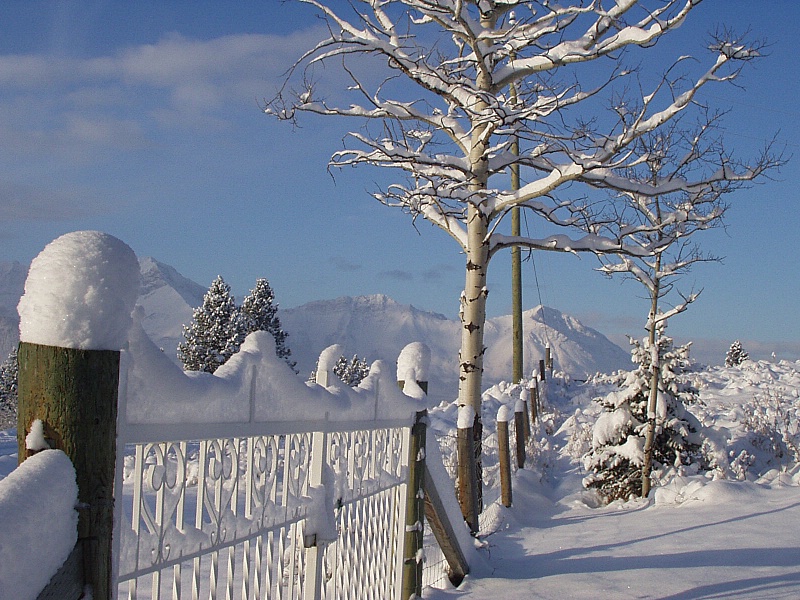
The photo is taken near the Flathead Range in the Crowsnest Pass in winter. The Flathead Range makes up part of the Continental Divide between Alberta and British Columbia.

For history buffs courtesy of Peakfinder.com: "The Flathead Range was named in 1924 after a tribe of Indians that lived in northwestern Montana. Some members of the tribe wrapped the soft-boned heads of their infants against a board so as to shape their skulls in a preferred manner."

Photo Credit: tipkodi CC=nc-flickr. Click to enlarge.

Sunday, 1 January 2012


This photo is taken in Kananaskis Provincial Park, Alberta.


With the New Year of 2012 upon us, I wish everyone a blessed and glorious time. Personally, I'm looking forward to the change of ages from Pisces to Aquarius in December: a new age which is said to bring peace, harmony and joyous love between people in a new "Golden Age". We will be leaving the Age of Pisces where people were forced to be under the control of others. Now is the time for every person to take control of their lives and see what measures they can assist in implementing to help others less fortunate or to see that proper safety measures are taken in environmental issues.

There are always a variety of avenues to be considered: safe health products, better standards for drinking water...i.e. is chlorine really safe to use? Chlorine is used in a variety of ways: to safeguard tap water, in disposable diapers, in bleach, in swimming pools, etc. The dangers of chlorine and its by-products is that it is linked to various forms of cancer. Are the chemicals used in household products, medical prescriptions, personal care items such as deodorant, soap, perfume, cosmetics, safe? Most are not. It's time for people to take an interest in what products they use and how they affect their lives and the lives of their families. Corporate companies are interested in the financial bottom line, not consumers' safety.

On a less serious note, winter did not really arrive in Toronto. It came for a couple of days after Christmas with a scattering of snow followed by mild temperatures and today it's raining with a temperature of 4C. The weather folks say it'll be a mild winter. Global change or is the planet wobbling lower these days? Ever noticed how the sun is located in a different position than when you were younger. Pay attention to where it sits above the horizon and where it sets. In 2010 in April a friend and I noticed that the sun was at an odd height at 4pm: quite high in the western sky when it should have been lower. Who out there has noticed the ground tremble just a little in the late afternoon or evening? A tremble almost imperceptible, but there. Any tremble more than this and my birds act up. Do you pay attention to what is going on around you, or are you more concerned about what's for dinner, or what movie you're going to, or how many emails you have to slog through at work? Take a few minutes and take a good look around you, feel the quiet in the park or is there something else there you didn't quite see before.

Some food for thought for the coming year. Be alert to new things and just maybe you'll experience something profound and new.

Photo Credit: D'arcy Norman CC=flickr.

Tuesday, 20 December 2011


This is taken along Highway 22 in southern Alberta showing the Livingston Range in first snow.

Of late I have been quite busy with personal matters and unable to post regularly. I hope things will settle down after the Christmas holidays so I can get back to doing my book reviews and historical posts which many of you enjoy.


Photo Credit: Gord McKenna CC=nc-nd-flickr.

Monday, 31 October 2011


This autumn view is of the Crownsnest River with Crowsnest Mountain on horizon in southern Alberta.

Photo Credit: tipkodi CC=nc-flickr. CLICK TO ENLARGE.

Saturday, 28 May 2011


This photo is of the Bow River at Canmore, Alberta.

Of late I've been stricken with a nasty infection that has decided to loosen it's hold. Thus, I'm on the road of repair and better health. And, just maybe, I'll be able to enjoy a walk in this lovely forested area again.


Photo Credit: 2BFotoguBkarten CC=nc-nd-flickr.

Tuesday, 22 February 2011

Hiking Trails - Bow Glacier Falls


[1] Highway 93N - Icefields Parkway headed south to Bow Lake and Crowfoot Glacier on Mt. Crowfoot, 3050m (10,007 ft).

This hike is located in Banff National Park just off the Icefields Parkway. Please consider there is the possibility of rapid weather changes and take rain gear along as sudden showers are likely in and around the many icefields present in this area.

Distance: 4.6km one way, takes about 2 hours for one way
Elevation Gain: 155m
Trailhead: 36km north of the Lake Louise Junction on the Icefields Parkway. Turn off at the Num-Ti-Jah Lodge Access Road on the west side of the highway. The trailhead kiosk is 400m down this access road.


[2] Num-Ti-Jah means ‘pine marten’.

The mountain behind the lodge is Mount Jimmy Simpson 2966m (9730 ft) named after an early well respected outfitter who arrived from England in 1896, built the Lodge Num-Ti-Jah for his patrons. Jimmy Simpson died in 1972 at the age of 95. Simpson commented about the area: "There is absolutely nothing in the city to give us the same feeling as the great, mysterious things of nature even though they be stone and ice. It is only among them that we feel the utter helplessness and insignificance of ourselves."*


[3]

For those interested in staying at the Num-Ti-Jah Lodge I have provided the link. Though a bit pricey I think a full package with breakfast, packed lunch and dinner would be the ticket for a glorious stay of a night or two.


[4]


[5]

The pointed bump to the right of Bow Glacier is Portal Peak, 2911m (9550 ft) was named by Charles s. Thompson in 1916. This is in the direction the hike destination to Bow Glacier Falls.

The trail follows the northern edge of Bow Lake.


[6]

There are several bridges that cross streams.


[7]

At the lake outlet there are gravel bars and a plain with the falls visible in the distance.


[8]


[9] Gravel bars


At the end of the plain are a set of stairs needed to reach the falls. There are about 65 steps to the top, set in an irregular fashion.


[10]


[11]

As the hiker ascends the stairs various views of the Bow River gorge can be seen.


[12]


It is near here, before the top of the stairs are reached , where a branch off trail to the left goes to the Bow Hut (run by the Alpine Club of Canada. or those considering this route there is a daunting bridge of a large limestone boulder that crosses the gorge.

Above the stairs the trail reaches a crest on a glacial moraine where there is a 45 minute hike to the falls.


[13]

The falls originate from a fair sized lake below Bow Glacier which is unseen from below lying in a basin below the toe of the receding glacier.


[14]


[15]

Bow Glacier Falls are the headwater of the Bow River.


[16]
View from bottom of bow glacier falls.


[17]- View from sitting near base of Bow Glacier Falls looking down to Bow Lake.

For those intrepid hikers who happened to carry along proper equipment and ropes a scramble up the rocks to the glacial lake at the toe of the Bow Glacier will reveal an awesome sight.


[18]


[19] Bow Glacier with view of the sharp spire of St. Nicholas Peak, 2970m (9750 ft) located on the eastern edge of the Wapta Icefield.


Photo Credits: [1]-Alaskan Dude CC=flickr, [2]-cblee CC=nc-sa-flickr, [3]-surfma CC=nc-flickr, [4][12]-richd777 CC=nc-sa-flickr, [5]-wikimedia commons, [6]-retropc CC=nc-sa-flickr, [7][9]-Gouldy99 CC=nc-nd-flickr, [8]-bolinhanyc CC=nc-flickr, [10][11][14]-BinoCanada CC=nc-sa-flickr, [13]-felix63 CC=nc-nd-flickr, [15]-miss a CC=nc-sa-flickr, [16][17]-lyzadanger CC=nc-sa-flickr, [18][19]-Stefatty CC=nc-sa-flickr.

Sources: *peakfinder.com
ParksCanada

Friday, 7 January 2011

Bow Lake


This photo is of Bow Lake just off the Icefields Parkway.


Photo Credit: karenwithak CC=nc-nd-flickr.

Tuesday, 28 September 2010


My computer problems will be soon rectified. Thus, book reviews and other assorted posts will resume in due course.

To pass the time until then please enjoy this photo of Spirit Island in Maligne Lake, Jasper National Park in Alberta.

Photo Credit: alpeck99 CC=nc-nd-flickr.

Thursday, 29 July 2010

Hiking Trails - Glacier House


[1]-nearing Glacier National Park gate with the Sir Donald Range in the background

This post is for Robb Kloss of Ruahine Ramblings in New Zealand who is celebrating his birthday. Please pop over to wish him a good one.


Glacier House is the focal point for ten hiking trails in Glacier National Park, British Columbia. These ten backcountry trails that lead out of the Illecillewaet Campground date from the early days of railway tourism and still follow the routes laid out by the original Swiss Guides of Glacier House.


[2-Rogers Pass rest stop with Illecillewaet Glacier in background - click to enlarge]

Illecillewaet Campground is located 2.6 km west of the Rogers Pass Discovery Centre located in an avalanche shelter on the Trans-Canada Highway (hwy 1).


[3 - Rogers Pass Discovery Centre built in an avalanche shelter - click to enlarge
This avalanche shelter was built as a protection against the multiple avalanches that occur in Rogers Pass. Every year there is a memorial for those who lost their lives in the March 4, 1910 avalanche. This year marks the 100th year anniversary.]

The campground is open from late June to September 1 and offers 60 campsites, flush toilet washroom buildings, log kitchen shelters, food lockers, firewood and drinking water supplies.


[4 - Illecillewaet Campground]


[4A-Gopher (Richardson Ground Squirrel) - click to enlarge]


Go to the second parking lot past the campground, walk up the rail trail toward the Wheeler Hut for about 100m, crossing the Illecillewaet River.


[5- Trail crosses the Illecillewaet River]


There is an interpretative trail at the Glacier House ruins. Glacier House had been demolished in 1929.


[6-Foundations of Glacier House]

Below the Great Glacier (later called the Illecillewaet) and on the main line, the C.P.R. constructed Glacier House - a traditional C.P.R. hotel. Originally, the hotel was built to eliminate the need to haul heavy dining cars over the pass. Trains were conveniently scheduled so that passengers could lunch at the hotel.


[7-Glacier House former wall]

Glacier House quickly became a popular tourist attraction and facilities were eventually expanded to include 90 rooms and related services.


[8-Glacier House old furnace remains]

The C.P.R. brought mountain climbing guides from Switzerland and the hotel became a focal point for mountaineering in the Selkirks and North America.


[9 -Winter scene at Glacier House. Note snow piles surrounding train tracks and station c.1885-1890s - for photo clink on link to Glenbow Archives]

After a massive avalanche on March 10, 1910 that killed 58, the CPR admitted defeat to the weather conditions of Rogers Pass and began in 1913 to build a tunnel underneath Mount Carroll (Macdonald) which was called the Connaught Tunnel. In 1917 the Connaught Tunnel opened for rail traffic with a distance of 1.6km to bypass the dangerous Rogers Pass.

Glacier House continued to operate until 1925 losing its business to the Banff Springs Hotel and the Chateau Lake Louise, as well as the retreat of the Illecillewaet Glacier which had been 150 feet from the hotel.


Source: Source: ParksCanada - Rogers Pass

Photo Credits: [1]-RegNatarajan CC=flickr, [2]-CanadaGood CC=nc-nd-flickr, [3]-Canoe Too CC=nc-nd-flickr, [4][6][7][8]-elinar CC=nc-flickr, [4A]-Jason Liew CC=nc-sa-flickr, [5]-kleinmantara CC=nc-sa-flickr.

Friday, 11 June 2010

Hiking Trails - Wilcox Pass

The hiking trail over Wilcox Pass was used frequently before the Icefields Parkway opened in 1940. It is best in late June through to mid-August, although snow can remain in Wilcox Pass until late July. Wilcox Pass is in Jasper National Park, Alberta and accessed just off the Icefields Parkway (Highway 93).


[1- Indian Paintbrush near the Icefields Parkway - click to enlarge]


The trailhead begins at the Wilcox Creek Campground with the distance to Wilcox pass is 4.0 km (2.5mi) one way. To take the full hike one-way from the Wilcox Creek Campground to Tangle Falls is 11.2km (7.0mi).


Half day to day trip
Allow 1.5 to 2 hours to Wilcox Pass
Elevation gain: 335m (1,100ft)
Maximum elevation: 2375m (7800ft)

To reach the trailhead take the Icefields Parkway Hwy 93 to the Wilcox Creek Campground on the east side of the highway 2.8km (1.7mi) south of the Icefields Centre or 1.9km (1.2mi) north of the Banff-Jasper boundary at Sunwapta Pass.

This hike is considered one of the best day hikes in Jasper National Park.


[2- Golden Mantle Ground squirrel aka Chipmunks - click to enlarge]

These little guys seem to populate the wood piles near campgrounds wherever one travels in the mountains.


The Wilcox Campground road is at an elevation of 2040m with a steep climb through alpine forest.


At approximately the 1.7km mark the trail emerges above the treeline gaining 120m in less than a kilometre.

In another 2.5km there is a steep climb to flat alpine meadows and the viewpoint for the Athabasca Glacier.


[3- Viewpoint of Columbia Icefield, Mt. Athabasca to left with Mt. Andromeda behind, the Athabasca Glacier in the middle and Mt. Kitchener and the Snow Dome on the right - from the Wilcox Pass Trail - click to enlarge]


Only a small portion of the Columbia Icefield is visible from the Icefield Parkway. The Athabasca Glacier is the most accessible and visible of the glaciers which flow from the Icefield, but there are numerous others. Over three hundred square kilometres in area, the depth of the icefield varies from 100 to 365 metres. The average annual snowfall on the upper reaches is seven metres.

From the viewpoint the trail moderates, opening out onto a ridge overlooking the Icefields Parkway and the Athabasca Glacier. The hiker can feast his/her eyes upon the massive ice-covered Mount Athabasca (3491m) (11454ft), Mount Andromeda (3450m) (11,319ft), the Snow Dome (3460m) (11,399ft) and Mount Kitchener (3511m) (11,500ft).

Mt Kitchener was named in 1916 after Horatio Herbert Kitchener (Viscount Kitchener), a British Field Marshall who organized the British armies at the beginning of WWI. He was lost when HMS Hampshire struck a mine in 1916.


[4 - Snow Dome and Mt. Kitchener from the Wilcox Pass trail - click to enlarge]


Norman Collie and Hermann Woolley completed the first ascent of Mount Athabasca on August 18, 1898. Collie described a vast icefield that stretched westward and surrounded by unknown peaks.


[5 - Snow Dome Glacier above Mt. Kitchener - click to enlarge]


The Snow Dome was named in 1898 by J. Norman Collie . This dome-shaped mountain is covered by the Columbia Icefield. The water produced from this mountain flows into three oceans through the Saskatchewan and Nelson rivers to the Atlantic, though the Columbia to the Pacific, and through the Athabasca and Mackenzie Rivers to the Arctic.


[6 - View from Wilcox Pass trail toward Mt. Andromeda, the Athabasca Glacier and Mt. Kitchener on right - click to enlarge]


Past the viewpoint the trail climbs along the edge of a creek, then levels out across alpine tundra and heads northwest into the long U-shaped pass between Wilcox and Nigel peaks.


[7 - Looking back to Mt. Athabasca and Mt. Andromeda from the Wilcox Pass Trail - click to enlarge]


Here the wildflowers grow close to the ground.


[8 - Wilcox Pass trail - click to enlarge - Mt. Wilcox is above horizon of hill on left side]


At 4.0km is the summit of Wilcox Pass (2374m). Wilcox Pass and peak are named after Walter Wilcox, whose party first crossed the pass in 1896 on horseback. The pass became the usual route north as it avoided the Sunwapta Gorge and the Athabasca Glacier, which nearly blocked the valley below.


[9 - on Wilcox Pass trail - click to enlarge]


It is here and at the other end of the pass that the hiker will find Bighorn Sheep.


[10 - Rocky Mountain Bighorn Sheep at Wilcox Pass - click to enlarge]


[11 - Wilcox Pass trail with Rocky Mountain Sheep - click to enlarge]


Here the hiker can often find small herds of Rocky Mountain Sheep grazing.


[12 - Wilcox Pass - click to enlarge]


[13 - NW on Wilcox Pass trail with Mt. Wilcox in background - click to enlarge]


[14 - Wilcox Pass - click to enlarge]


[15 - Wilcox Pass - click to enlarge]


To continue on to Tangle Falls the route continues north across the pass to trail makers or cairns at the 7.1km mark, where there is a steep descent into the forest. Stick to the left side below Mount Wilcox. At about 8.6km, the trail crosses to the left of the creek where it becomes more defined. Here the slope goes from moderate to steep on the descent south of Tangle Creek.

At 11.2km is the Tangle Creek trailhead (1860m) with the Icefields Parkway 200m south of Tangle Falls and 10km north of the Wilcox Creek trailhead.

Otherwise, at the rock cairn the hiker can begin to backtrack the way they came to return to the Wilcox Creek Campground.


[16 - Wilcox Pass - click to enlarge]


[17 - Coming down from Wilcox Pass - click to enlarge]


[18 - Mt. Athabasca with glacier - click to enlarge]


[19 - On Wilcox Pass Trail looking toward the Athabasca Glacier]


[20 -Mt. Kitchener beneath the Snow Dome]


Photo Credits: [1]-jdww CC=nc-nd-flickr, [2]-karenwithak CC=nc-nd-flickr, [3][16]-richd777 CC=nc-sa-flickr, [4][6][7]-A tea but no e CC=flickr, [5][9][13]-Alaskan Dude CC=flickr,[8][19]-BinoCanada CC=nc-sa-flickr, [10][11][12][14][17]-Feffef CC=nc-sa-flickr, [15]-canoe too CC=nc-nd-flickr, [18]-gordmckenna CC=nc-nd-flickr, [20]-DavidQuick CC=nc-nd-flickr,