Saturday, 31 July 2010

WINNER OF BOOK DRAW - THE CASE OF THE MISSING SERVANT


The winner of the book THE CASE OF THE MISSING SERVANT by Tarquin Hall is David Cranmer selected by the Annabet Randomizer. This book was supplied by Tarquin Hall's literary agency, Fletcher & Company. David, please email me with your mailing particulars. Thank you to everyone who entered.

Thursday, 29 July 2010

Hiking Trails - Glacier House


[1]-nearing Glacier National Park gate with the Sir Donald Range in the background

This post is for Robb Kloss of Ruahine Ramblings in New Zealand who is celebrating his birthday. Please pop over to wish him a good one.


Glacier House is the focal point for ten hiking trails in Glacier National Park, British Columbia. These ten backcountry trails that lead out of the Illecillewaet Campground date from the early days of railway tourism and still follow the routes laid out by the original Swiss Guides of Glacier House.


[2-Rogers Pass rest stop with Illecillewaet Glacier in background - click to enlarge]

Illecillewaet Campground is located 2.6 km west of the Rogers Pass Discovery Centre located in an avalanche shelter on the Trans-Canada Highway (hwy 1).


[3 - Rogers Pass Discovery Centre built in an avalanche shelter - click to enlarge
This avalanche shelter was built as a protection against the multiple avalanches that occur in Rogers Pass. Every year there is a memorial for those who lost their lives in the March 4, 1910 avalanche. This year marks the 100th year anniversary.]

The campground is open from late June to September 1 and offers 60 campsites, flush toilet washroom buildings, log kitchen shelters, food lockers, firewood and drinking water supplies.


[4 - Illecillewaet Campground]


[4A-Gopher (Richardson Ground Squirrel) - click to enlarge]


Go to the second parking lot past the campground, walk up the rail trail toward the Wheeler Hut for about 100m, crossing the Illecillewaet River.


[5- Trail crosses the Illecillewaet River]


There is an interpretative trail at the Glacier House ruins. Glacier House had been demolished in 1929.


[6-Foundations of Glacier House]

Below the Great Glacier (later called the Illecillewaet) and on the main line, the C.P.R. constructed Glacier House - a traditional C.P.R. hotel. Originally, the hotel was built to eliminate the need to haul heavy dining cars over the pass. Trains were conveniently scheduled so that passengers could lunch at the hotel.


[7-Glacier House former wall]

Glacier House quickly became a popular tourist attraction and facilities were eventually expanded to include 90 rooms and related services.


[8-Glacier House old furnace remains]

The C.P.R. brought mountain climbing guides from Switzerland and the hotel became a focal point for mountaineering in the Selkirks and North America.


[9 -Winter scene at Glacier House. Note snow piles surrounding train tracks and station c.1885-1890s - for photo clink on link to Glenbow Archives]

After a massive avalanche on March 10, 1910 that killed 58, the CPR admitted defeat to the weather conditions of Rogers Pass and began in 1913 to build a tunnel underneath Mount Carroll (Macdonald) which was called the Connaught Tunnel. In 1917 the Connaught Tunnel opened for rail traffic with a distance of 1.6km to bypass the dangerous Rogers Pass.

Glacier House continued to operate until 1925 losing its business to the Banff Springs Hotel and the Chateau Lake Louise, as well as the retreat of the Illecillewaet Glacier which had been 150 feet from the hotel.


Source: Source: ParksCanada - Rogers Pass

Photo Credits: [1]-RegNatarajan CC=flickr, [2]-CanadaGood CC=nc-nd-flickr, [3]-Canoe Too CC=nc-nd-flickr, [4][6][7][8]-elinar CC=nc-flickr, [4A]-Jason Liew CC=nc-sa-flickr, [5]-kleinmantara CC=nc-sa-flickr.

Monday, 26 July 2010

My Town Monday - Kicking Horse Pass - The Big Hill


[1-Looking SW toward Kicking Horse Pass, Mt. Stephen on far right - click to enlarge]


When the Canadian Pacific Railway continued construction on its transcontinental railroad in 1885 the Big Hill was the most difficult portion of the route. It was located in the Canadian Rockies west of the Continental Divide and Kicking Horse Pass.


[2-CP Empress 2816 backing up before running Morant's Curve -click to enlarge]


The rail line route along the Kicking Horse River was considered the worst. From the west end of Wapta Lake the original survey revealed a uniform grade of 2.2% (116 feet to the mile) to Ottertail required a 1,400 foot tunnel through Mount Stephen and exposure to avalanche paths. The CPR realized that digging this tunnel would delay things for a year. This resulted in a temporary alternate route being built instead. The new route descended at 232 feet per mile or 4.5%, more than double, passing Wapta Lake to the base of Mount Stephen, along the Kicking Horse to a point just west of Field, then climbing again the meet the original survey at Muskeg Summit.


[3 - CP Empress 2816 crosses the Ottertail - click to enlarge]

Three special reverse grade dead end spurs to control runaway trains were built. Runaways and deaths did occur despite the safety precautions. The Big Hill between Field and Hector that ran for eight miles was ‘temporary’ for almost 25 years. It took four engines to get 710 tons up the grade. Trains were limited to a certain number of cars; freights were allowed more and passenger trains less. The route was dangerous and very expensive to operate. The remains of one accident can be found near the Kicking Horse River campground.

Trains loaded with heavy dining cars and sleeping cars were unable to climb the Big Hill, resulted in the CPR building rest stops at Mount Stephen House and Glacier House.


[4 - CP Empress 2816 entering Field - click to enlarge]


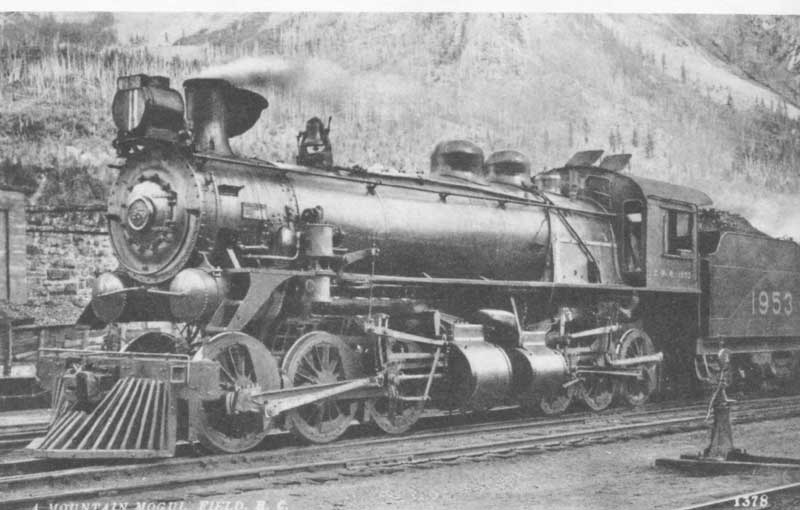
Special locomotives had to be built to haul the trains up the Big Hill. Heavy 2-8-0’s were enormous for their day, the first Consolidation type equipped with water brakes. Hundreds more would follow, larger and stronger, and were stationed at Field where a train stonehouse with turntable had been built for their storage and maintenance. Field had originally been known as the Third Siding until December 1884 when the CPR named it after C.W. Field, a Chicago businessman, whom they hoped would invest in their railroad.


[5 - Big Hill and CPR 1890]

Big Hill” on the CPR, 1890. Safety Switch No. 1 and its uphill spur are shown foreground and right; the truss bridge under the rear of the train, now known as the "Old Bridge", survives as a tourist attraction.

In 1909 the Big Hill was replaced by an engineering marvel, the Spiral Tunnels, reducing the grade to 2.2%, the norm for railroad tracks for maximum grade, at a cost of $1.5 million.


[6 - Spiral Tunnels in early 1920s - click to enlarge]

The tunnel under Cathedral mountain is 3255 feet long with a turn of 291 degrees, and the one under Mount Ogden turns through 217 degrees over 2992 feet. When the tunnels were bored, the measurements were off on one tunnel 1.5 feet when the two ends connected, and on the other tunnel, six inches.


[7 - CP Empress 2816 climbing rise to Spiral Tunnels - click to enlarge]


A bit of trivia about Mount Ogden: it was once the venue for a piano concert. A railway employee had been transferred and decided to move his small piano by loading it aboard a small push car. As he coasted through the lower tunnel he played his piano, much to the surprise of another railway employee who was patrolling the tunnel, watching for rockfall.


[8 - Spiral Tunnels map - click to enlarge]


There is a lookout just off the Trans-Canada Highway from which visitors can observe both portals of the tunnel. Passengers can ride this route, at least in the summer, on Great Canadian Railtours' "Rocky Mountaineer" train from Calgary to Vancouver.

For other participants for My Town Monday go here.


Sources: ParksCanada – Kicking Horse Pass Historical Site ,
TrainWeb.org
Wikipedia
Peakfinder.com
CP 2816 inaugural run 2001

Photo Credits: [1]-Matthew Klassen CC=nc-nd-flickr,[2][3][4][7]-Geoff S CC=nc-flickr, [5]-wikipedia, [6]-Sherlock77 (James) CC=nc-nd-flickr, [8]-Robert aka Bob CC=nc-nd-flickr.

Friday, 23 July 2010

Reflections (9)


This is Moraine Lake in the Valley of the Ten Peaks near Lake Louise, Banff National Park.

Photo Credit: brilang CC=nc-sa-flickr.

Thursday, 22 July 2010

Code Blue by Richard L. Mabry, M.D. (Book Review)


“In the first book of the Prescription for Trouble series, “Code Blue” means more to Dr. Cathy Sewell than the cardiac emergency she has to face. It describes her mental state as she finds that coming back to her hometown hasn’t brought her the peace she so desperately needs. Instead, it’s clear that someone there wants her gone…or dead.

“Cathy returns to her hometown seeking healing after a broken relationship, but discovers that among her friends and acquaintances is someone who wants her out of town…or dead. Lawyer Will Kennedy, her high school sweetheart, offers help, but does it carry a price tag? Is hospital chief of staff, Dr. Marcus Bell, really on her side in her fight to get hospital privileges? Is Will’s father, Pastor Matthew Kennedy, interested in advising her or just trying to get her back to the church she left years ago? When one of Cathy’s prescriptions almost kills the town banker, it sets the stage for a malpractice suit that could end her time in town, if not her career. It’s soon clear that this return home was a prescription for trouble.”


Dr. Cathy Sewell, a capable surgeon, has returned home to Dainger, Texas after breaking up with her fiancé hoping to get her life back on track. Her life is now filled with new challenges: two men who are trying to date her, a medical colleague and her high school sweetheart; someone is trying to discredit her medical abilities; and her life is in danger from the driver of a black SUV.

Situations from her past threaten to overwhelm Cathy, who questions her faith in God, and the old feelings that surface for a former sweetheart whom she left to attend college. She blames God for the death of her parents in an accident that prevented them from attending her graduation from medical school.

The plot moved quickly once the medical detail appeared with clues being provided, bit by bit, to reveal there were a few citizens who found fault with Cathy’s return. As her problems mount, Cathy feels vulnerable, self-critical and questions her sanity while trying to prove herself capable before her colleagues, patients and to herself.

All the characters had definite attitudes and mannerisms that fit in how they dealt with problematic situations. The details surrounding the medical and legal aspects were realistic, although as to the latter there were a few things that raised my eyebrows over procedure.

There were several brilliant twists and turns with red herrings that kept me intrigued and surprised, as I had not seen them coming. There were a couple of places where the consequences of a particular action could only lead in one direction. Despite this, the suspense built up to a thriller level toward the end which I thoroughly enjoyed.

Dr. Mabry demonstrated his expertise in the medical field while presenting the terminology in layman’s terms and gripping action. Also, he has done a deft job of conveying that God is always there waiting to assist those who reach out.

Dr. Mabry’s second novel in the series, Medical Error, will be available September 2010.

Review copy provided by Richard Mabry.

Paperback: 288 pages
Publisher: Abingdon Press
Author website: Richard L. Mabry, MD
Published: April 1, 2010

Available at:

Amazon.com

Amazon.ca

Amazon.co.uk

Wednesday, 21 July 2010

BOOK DRAW - THE CASE OF THE MISSING SERVANT by Tarquin Hall


Reminder for those wanting to enter the draw for this book on July 30, 2010. Please leave a comment below or at my review here.
WINNER IS DAVID CRANMER.

Thursday, 15 July 2010

Every Lost Country by Steven Heighton (Book Review)


From the inside flap:

“Lewis Book, a doctor with a history of embroiling himself in conflicts, and his daughter, Sophie, travel to Nepal to join a climbing expedition. One evening, as Sophie sits on the border between China and Nepal, watching the sun set over the Himalayas, she spots a group of Tibetan refugees fleeing from Chinese soldiers. When shooting starts, Dr. Book rushes toward the ensuing melee, ignoring the objections of Lawson, the expedition leader, who doesn’t want to get involved and spoil his chance to be the first climber to summit Kyatruk. Lawson is further enraged when Amaris, a Chinese-Canadian filmmaker recording the expedition, joins Book with her camcorder in hand. When the surviving Tibetans are captured just short of the border, Lawson and Sophie look on helplessly as Book and Amaris are taken away with them, down the glacier into China. From that point, Lawson continues his ascent, and the fugitives are caught in an explosive and thrilling pursuit that will test their convictions, courage and endurance.

“Inspired by an actual event, Every Lost Country is a gripping novel about heroism, human failings and what love requires. When is it acceptable to be a bystander, and when do life and loyalty demand more?”


Mr. Heighton provides an insider’s glimpse into the world of the Sherpa people in Tibet and Nepal, their customs and the simple life they live without material goods. Their spiritual leader is the Dalai Lama, representative of the life they aspire to. These people are the focus of this novel, a small group of Tibetan people seeking refuge and freedom in nearby Nepal. The Tibetans are caught in a conflict between keeping their traditional life and those who co-operate with the Chinese. The Chinese view any Tibetan as a rebel who does not support China’s occupation of their country.

Parallels of the two main plots are clear: the climb of the mountain and the plight of the Canadians in escaping the Chinese military. Multiple sub-plots are seen through the narratives of various characters. Each of the main and sub-characters work through their inner struggles over personal convictions and failures of their complicated backstories. They are seen initially as separate threads then woven together through different perspectives and finally coming together to become one.

Dr. Lewis Book who has spent most of his life working for Doctors Without Borders, living in crisis zones, is committed to assist victims without regard for his own safety. Acting true to character, Book rushes across the border into Tibet to assist those wounded in the shooting. Sophie, not to be abandoned once again by her father, follows. Amaris McRae, documentary filmmaker, sees her chance at a better story than the climbing expedition. When the Canadians are at the mercy of the elements of nature and the Chinese military they begin to understand Wade Lawson’s single-minded desire to conquer a mountain.

Wade Lawson is determined at any cost to reach the summit of Kyatruk at 7,878 metres. He goes through self-reflection during episodes of the psychological battle against the thin air and weather conditions of high altitudes. The climbing sequences are spectacular and gripping, especially at the end.

An engaging character was Zapa, the Himalayan yak, despite his meager part added to the tapestry of the novel.

This book kept me reading, mesmerized. Mr. Heighton’s evocative writing style lures the reader in with perfect detailed descriptions of the landscape, cultures, emotions, climate, dilemmas and sensations experienced by high altitude mountaineers; and complex characters who feel like friends after a couple of chapters. When the ending came I was satisfied with how it closed, but sorry to see it end. I will be reading more of this author's work.


Steven Heighton is the author of the novel Afterlands, which has appeared in six countries; was a New York Times Book Review Editors’ Choice along with a best book of the year selection in ten publications in Canada, the US, and the UK; and has been optioned for film. He is also the author of The Shadow Boxer, a Canadian bestseller and a Publishers Weekly Book of the Year. His work has been translated into ten languages, and his poems and stories have appeared in the London Review of Books, Poetry, Tin House, The Walrus, Europe, Agni, Poetry London, Brick, Best...

Special thanks to Julie Forrest for providing a review copy.

Book format: Hardcover, 352 pages
Genre: General Fiction (Literary Adventure)
Publisher: Knopf Canada
Author website: Steven Heighton
Available: May 4, 2010

Amazon.ca

Amazon.com – for Kindles

Chapters.indigo.ca